Why AI Adoption Is About Experience, Not Perfect Tools
April 02, 2026 · 3 min read · Ai Transformation
Someone challenged me recently.
"AI doesn't work," they said. "Here are my 3 attempts — all failures."
They weren't wrong about the failures. But they were wrong about the conclusion.
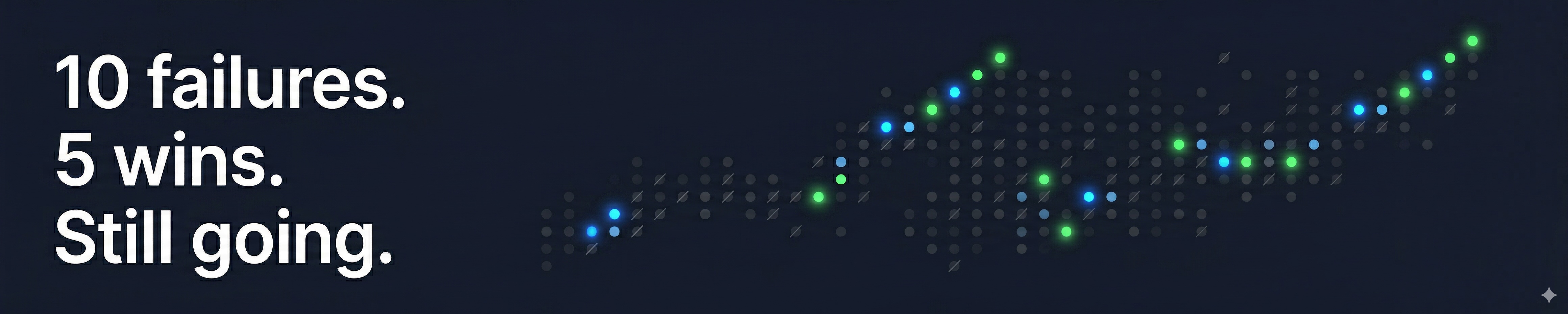
I shared my successful cases in response. What I didn't say out loud: statistically, I had more failures than them. About 15 losses to 5 wins. Not a great ratio on paper.
And yet I wasn't on their side of the argument.
The Gap Isn't Talent. It's Volume.
While they stopped at 3–4 attempts, I kept going. The result: roughly three times more cases, three times more experience.
That compounding matters more than any single result.
Some tasks I now know how to one-shot — build a Flutter app with a Node.js backend, or design a new solution in a few hours on top of a legacy product with 2,000+ tables. Not because the tools got better. Because I got better at using them.
Failure in AI adoption is not a signal to stop. It's data. It tells you where the sharp edges are — and how to route around them.
Why Most Teams Quit Too Early
The pattern is consistent across organizations:
A team picks up an AI tool. They run a few experiments. Some fail visibly. Someone senior says "we tried AI, it didn't work." The tool gets shelved.
What actually happened: they collected 3–4 data points and drew a conclusion that required 30.
Early AI failures are almost never about the tool. They're about:
- Prompting strategies that haven't been developed yet
- Workflows that weren't redesigned to accommodate AI output
- Expectations calibrated to magic instead of augmentation
- No feedback loop between what failed and what to try next
The organizations that win with AI transformation are not the ones with better tools. They're the ones willing to treat the learning curve as an investment, not a red flag.
What Changes After Enough Reps
There's a point — hard to define precisely, easy to feel — where AI stops being unpredictable and starts being a system you understand.
You know which tasks it handles cleanly. You know where it hallucinates and why. You know how to structure inputs to get consistent outputs. You know when to trust the result and when to verify.
That knowledge doesn't come from reading documentation. It comes from doing the work, absorbing the failures, and iterating.
The difference between a team that "tried AI" and a team that successfully adopted it is almost always just this: one stopped at the hard part, the other went through it.
The Actual Metric to Track
Stop tracking "did this AI attempt succeed or fail."
Start tracking:
- How many total attempts have we made?
- What patterns are we seeing in failures?
- How has our success rate changed over the last 20 attempts vs. the first 20?
If the success rate is improving, you're on the right path — even if absolute failures are still happening.
AI adoption at scale is not about eliminating mistakes. It's about developing the experience to know how to navigate around them.
The Bottom Line
Implementing new tools is not about the perfection of the tools.
It's about experience, about readiness to make mistakes, and about willingness to spend time figuring out how to work around the sharp edges.
Three failed attempts is a starting point, not a verdict.
The teams building real competitive advantage with AI right now aren't the ones who had the smoothest rollouts. They're the ones who kept going after the rough ones.
Have a question about AI implementation strategy or want to share where you're getting stuck? Reach out — the sharp edges are more navigable than they look.